Greatest Eclipse
02:55:26.9 UTC
Quick answer: On 22 July 2028, a total solar eclipse crosses the Kimberley, remote central Australia, New South Wales including Sydney, and southern Aotearoa New Zealand. Totality lasts up to about 5 minutes 10 seconds on the centre line; every partial phase requires proper solar eye protection.
The umbra makes landfall on the West Australian coast at 06:48 local, sweeps southeast across the Outback, crosses the Great Dividing Range, and exits over the South Pacific after grazing Aotearoa New Zealand's South Island.
A path line cannot choose a lawful, reachable site with a clear solar aspect. Each regional guide addresses the evidence and constraints that materially differ there.
Use centre-line timing as a starting point, then plan fuel range, permissions, remote-road conditions, heat exposure and communications for the exact route.
Read the Kimberley guide →Check exact coordinates and time zones before committing: Alice Springs city centre is partial, while totality crosses more remote country elsewhere in the region.
Read the Central Australia guide →Totality arrives shortly before winter sunset. A low north-western Sun makes terrain screening, winter roads and safe post-eclipse travel central to site selection.
Read the South Island guide →City-center eclipse circumstances are listed below. Times are local; magnitude is the apparent fraction of the Sun's diameter covered at greatest eclipse.
The Sun has been eclipsed somewhere on Earth roughly once every eighteen months — but for any given patch of ground, the wait is closer to four centuries. Here is the order of events.
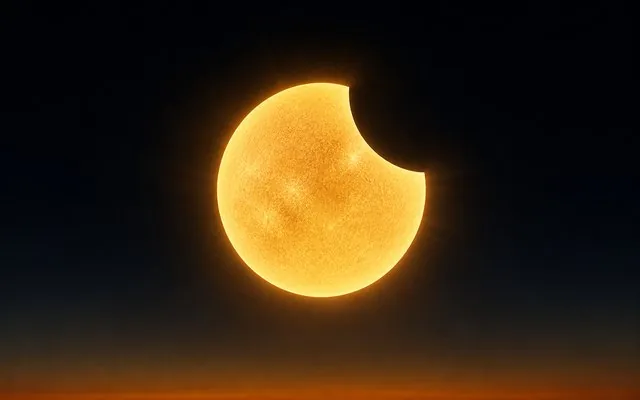
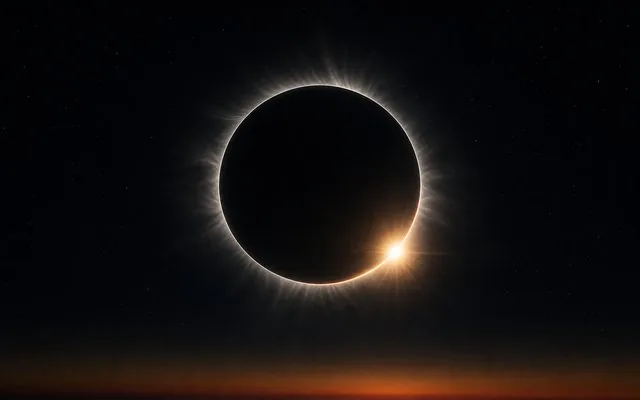
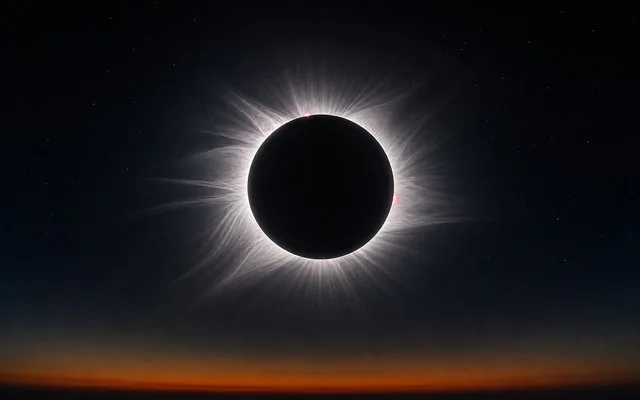
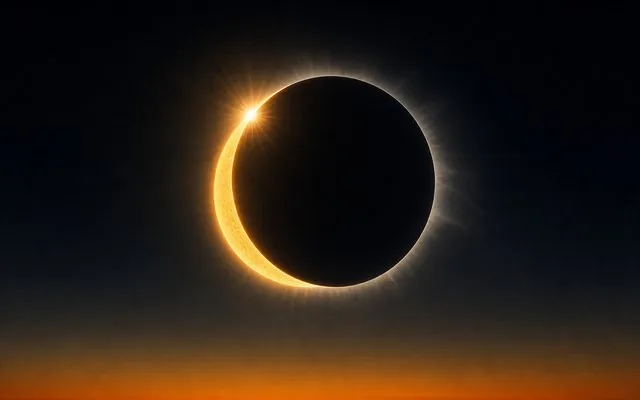
The partial phases need certified eye protection. Totality itself — and only totality — is safe to view with the naked eye, and the only time you should ever look directly at the Sun.
During every minute the Sun is not 100% covered, direct viewing causes immediate, painless and permanent retinal damage. There is no warning sensation.
The moment the Sun's photosphere is entirely blocked — and not one second before — you are looking at the corona of a star with your own eyes. It lasts only minutes. Don't watch it through glass.
Everything you need to know about the 2028 total solar eclipse across Australia and Aotearoa New Zealand.
In Sydney, the partial phase begins at 12:40 p.m. AEST on July 22, 2028. Maximum occurs at 2:01 p.m. AEST, totality lasts 3 minutes 48 seconds, and the event ends at 3:14 p.m. AEST.
The best city-center viewing locations listed here include Bourke (4:06 totality), Dubbo (3:50), Sydney (3:48), Queenstown (2:54), and Dunedin (2:51). Broome and Alice Springs see deep partial eclipses at their city centers.
The maximum duration of totality is about 5 minutes 10 seconds along the central path, though duration varies by location. City-center examples include Sydney at 3 minutes 48 seconds, Bourke at 4 minutes 6 seconds, and Dubbo at 3 minutes 50 seconds.
Use solar viewers that conform to ISO 12312-2 during every partial phase. Remove them only after totality has begun at your exact location, and replace them immediately when bright photosphere returns. Never look at the partial Sun without proper eye protection.
Melbourne will experience a deep partial event but not totality. The partial phase begins at 12:32 p.m. AEST and reaches maximum at 1:52 p.m. AEST. For totality, travel north toward the New South Wales path, including Bourke, Dubbo, or Sydney.
Bureau of Meteorology station summaries offer a documented comparison: Sydney Observatory Hill reports July means of 12.0 clear days and 8.7 cloudy days from a 1955–2010 cloud record, while Bourke Airport reports 13.0 clear and 3.4 cloudy days from a shorter 1999–2009 record. These monthly station statistics are not an eclipse-day forecast or viewing probability. See the weather evidence and limitations guide, then use current forecasts close to the event.
Yes, you need a solar filter for your camera during partial phases. Remove it only during totality. A telephoto lens (200mm+) helps capture detail. Never look through an unfiltered camera viewfinder at the partial eclipse.
Total solar eclipses are rare for any specific location. Sydney last experienced totality in 1857 and published eclipse calculations place the next Sydney totality in the 29th century, so the 22 July 2028 event is exceptional for the city. Australia sees total eclipses at irregular intervals, so it is better to plan from a specific eclipse path than from an average cadence.
Sydney last had city totality on 26 March 1857, Melbourne on 23 October 1976, Brisbane on 7 August 1901, and Adelaide on 4 March 1802. Australia last had totality on 20 April 2023, and Aotearoa New Zealand last had totality on 31 May 1965 in Northland. Queenstown's next listed city-center totality is 22 July 2028. Timeanddate's current city pages list no total solar eclipse before 2200 for Auckland eclipse history, Christchurch eclipse history, Wellington eclipse history, or Canberra eclipse history; Perth's page lists the next city totality as 31 May 2068, with no past city-center totality in that same accessible window.
Use viewers that conform to ISO 12312-2 and buy from a supplier on the current American Astronomical Society viewers and filters list or an authorised dealer. An ISO logo or printed number alone does not prove conformity. Inspect viewers before every use and discard damaged or untraceable products.
For totality: ISO 100-400, f/8-f/11, 1/1000s to 1/30s depending on corona detail desired. Use a solar filter for partial phases. Bracket exposures during totality. A 200-600mm lens is ideal. Remove filter only during totality.
Yes, certified viewers are designed to fit over prescription eyewear. Put them on over your regular glasses. Some vendors offer clip-on solar filters for prescription glasses. Never use regular sunglasses as protection.
Animals often display confusion during totality. Birds return to roost, nocturnal animals may emerge, and farm animals often return to barns. Pets may become anxious. Keep pets indoors or on leashes during the event.
Tasmania will see a partial phase but not totality. Timeanddate Hobart details lists Hobart maximum at 1:56 p.m. AEST on 22 July 2028 with magnitude 0.781, beginning at 12:40 p.m. and ending at 3:07 p.m. For totality, travel to mainland Australia or Aotearoa New Zealand's South Island.
Eclipse predictions from NASA GSFC Eclipse Website and Fred Espenak's calculations.
City timing data verified against NASA GSFC interactive eclipse map.
Weather comparisons use named Bureau of Meteorology station climatologies with their displayed periods and metric limits; they are not eclipse-minute forecasts.
Last updated: ·
Next review: