Eclipse Glasses: Conforming Solar Viewers vs Sunglasses
During every partial phase of the 2028 eclipse, direct viewing requires special-purpose eclipse glasses or a handheld solar viewer shown to conform to ISO 12312-2. Sunglasses — any sunglasses — will not protect you.
Commercial disclosure: As of 19 July 2026, the safety links on this page are editorial references, not affiliate links. The project does not sell, test, certify, approve, or rank solar viewers.
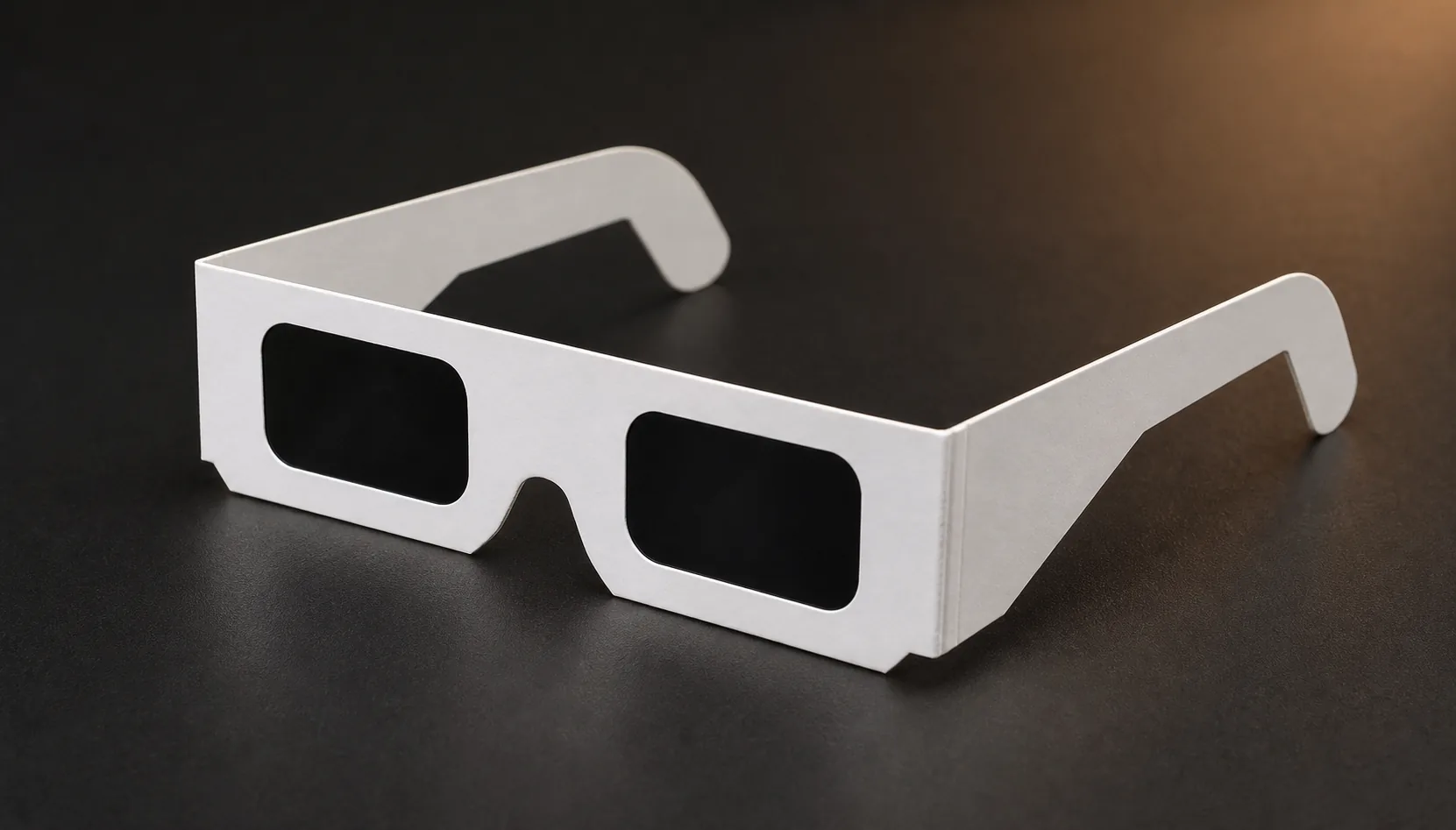
Why sunglasses are never enough
It is tempting to assume that very dark sunglasses, or several pairs stacked together, must be dark enough. They are not. NASA states that safe solar viewers are thousands of times darker than ordinary sunglasses and that sunglasses are unsafe for direct solar viewing regardless of tint. Stacking sunglasses, exposed film, smoked glass, CDs, and other improvised filters do not establish compliance with a solar-viewer safety standard. Retinal injury from direct Sun viewing can be permanent; see the solar-retinopathy guide.
What "ISO 12312-2" actually means
ISO 12312-2 is the international standard for filters used for direct observation of the Sun. ISO writes standards but does not test or approve individual products; the American Astronomical Society's explanation of ISO 12312-2 says a product should not be described as “ISO certified,” “ISO approved,” or “ISO registered.” Conformity is assessed through appropriate laboratory testing. An ISO number printed on a product or package is therefore a claim to investigate, not proof by itself.
How to verify your glasses are genuine
A consumer cannot prove spectral performance by looking at a filter. Visual checks can reject an obviously unsafe or damaged viewer, but passing those checks does not replace traceable laboratory testing. The AAS viewer-check guidance recommends establishing provenance as well as condition:
- Trace the supply chain. Buy directly from a manufacturer on the current AAS supplier list or from one of that manufacturer's publicly identified authorised dealers. A familiar maker's name printed on unknown merchandise is not enough.
- Use indoor visibility as a rejection test. If ordinary furnishings, screens, or room lighting are clearly visible through the viewer, it is not dark enough for solar observing. Passing this check does not prove conformity.
- Inspect every filter before every use. Discard a viewer if the filter is scratched, punctured, torn, creased, separating from its frame, or otherwise damaged.
- Follow the supplied instructions. Keep packaging and care directions, especially when distributing viewers to children, schools, clubs, or public-event attendees.
Counterfeit warning signs
Counterfeit and substandard glasses flood the market before every major eclipse. Treat these as red flags:
- No manufacturer identity or supply chain that can be matched to the current AAS supplier list.
- An ISO 12312-2 claim presented as marketing text without traceable evidence from the maker.
- You can clearly see indoor lighting, your phone screen, or surroundings through them.
- Visible scratches, creases, wrinkles, or pinholes in the filter material.
- An anonymous marketplace listing whose seller cannot identify the manufacturer or authorised distribution path.
- Packaging that misspells the standard or copies branding from a known maker.
If a pair fails any of these checks, do not use it. Replacement glasses are inexpensive; an eye injury is not.
Use the current AAS supplier list
Supplier status can change, and counterfeit products can copy a legitimate brand. Check the current AAS Suppliers of Safe Solar Viewers & Filters list at the time of purchase. Buy directly from a listed manufacturer or one of its publicly identified authorised dealers, then match the maker and product information on the viewer and packaging to what you ordered. Retain the order record and original instructions if you are buying in bulk for a school, workplace, club, family group, or public event.
A supplier's absence from the list does not by itself prove that its product is unsafe; it means the AAS has not given consumers the same verification basis for that supplier. This project does not maintain a parallel approved list and does not endorse a particular brand.
Telescopes, binoculars and cameras
Eclipse glasses and handheld viewers are for unaided direct viewing; they do not make an unfiltered telescope, binoculars, or camera safe. NASA instructs observers to secure a suitable solar filter over the front of the optics and to seek expert advice before using optical equipment. ISO 12312-2 applies to direct solar viewers, not to a complete telescope, binocular, or camera filter assembly, so use a purpose-built product exactly as its supplier directs.
The one moment you can take them off
During totality — and only while the Moon completely covers the Sun's bright face — unaided viewing without a solar filter is safe. NASA says to replace the viewer as soon as any part of the bright Sun reappears. If you are outside the path of totality, there is no filter-off interval. Confirm your location and local totality window on the interactive map; different rules apply to magnifying optics, even during totality, so follow expert equipment guidance.
Frequently asked questions
Can I use regular sunglasses to watch the eclipse?
No. Ordinary sunglasses, no matter how dark, are not safe for direct solar viewing. Use special-purpose eclipse glasses or a handheld solar viewer from a traceable supplier whose product has been shown to conform to ISO 12312-2.
How do I know if my eclipse glasses are certified?
An ISO mark or a dark-looking filter does not prove safety. Trace the viewer to a manufacturer on the current AAS supplier list or one of its identified authorised dealers, follow the maker's instructions, and discard filters that are torn, scratched, punctured, loose, or otherwise damaged.
Can I reuse glasses from a previous eclipse?
Current AAS guidance permits reuse when viewers are less than 10 years old, their manufacturer had them tested by a properly accredited laboratory and found to conform to ISO 12312-2, and the filters remain undamaged and have been stored correctly. Follow the maker's instructions and discard any questionable viewer.
Safety and conformity sources
- NASA Science: Eclipse Viewing Safety — partial-phase protection, totality, indirect viewing, and front-mounted filters for optics.
- AAS: About the ISO 12312-2 Standard — what conformity means and why “ISO certified” is inaccurate.
- AAS: How to Tell If Viewers Are Safe — provenance, rejection checks, and damage inspection.
- AAS: Suppliers of Safe Solar Viewers & Filters — the maintained supplier and authorised-dealer reference.
- AAS: How to View a Solar Eclipse Safely — use, storage, reuse, cleaning, and totality instructions.
Review limitation: Mark checked this page against the sources above on 19 July 2026. It has not been medically reviewed and cannot assess an individual injury. If you develop visual symptoms after Sun exposure, see the eye-safety guide and seek professional eye care.