Solar Eye Damage After an Eclipse
If you looked at the Sun and now something seems wrong with your vision, this page explains what may have happened and what to do next.
Review status: This page has not been reviewed by an optometrist, ophthalmologist, or other medical professional. It summarises the linked clinical and public-health sources and cannot diagnose an eye injury.
Seek care first. If you develop blurred central vision, a central blind spot, distorted shapes, altered colour, or persistent light sensitivity after looking at the Sun, arrange a prompt assessment by an eye-care professional. Pain, redness, tearing, or a gritty sensation can reflect injury to the eye's surface rather than the retina and also warrants professional assessment. The US National Eye Institute's eclipse guidance describes both solar retinopathy and photokeratitis and advises seeking medical attention for symptoms after intense Sun exposure.
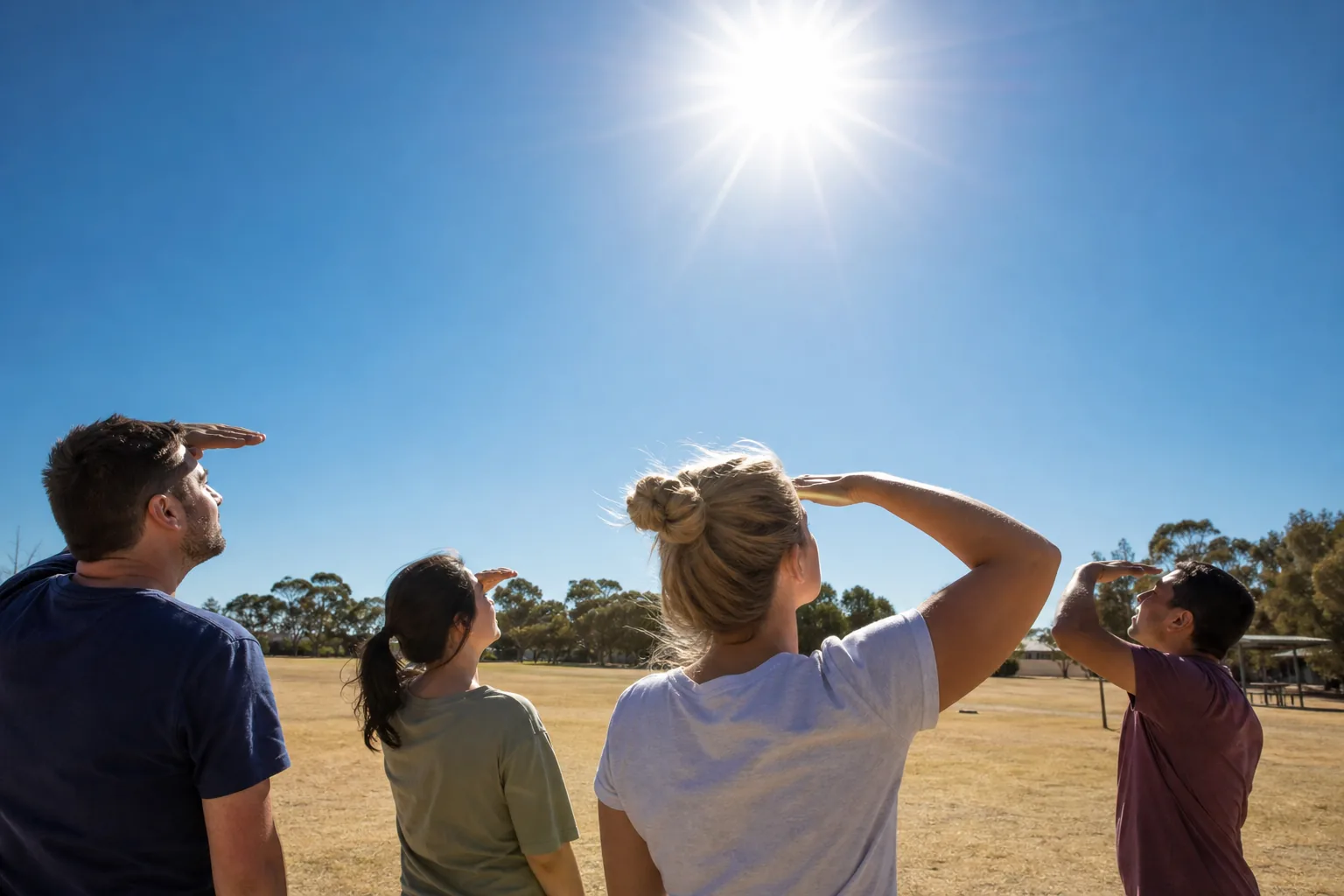
What is solar retinopathy?
Solar retinopathy (also called solar maculopathy or photic retinopathy) is injury to retinal tissue caused by intense light exposure, classically from looking at the Sun or an eclipse. It usually affects the foveomacular region responsible for detailed straight-ahead vision, so injury can produce a smudge or blind spot at the point where a person is trying to look. The American Academy of Ophthalmology's EyeWiki clinical overview describes the condition, diagnostic examination, and typical imaging findings.
The biological mechanism
Solar retinopathy is primarily described as a photochemical injury. Light energy absorbed in retinal tissue can generate reactive molecules that damage photoreceptors and the retinal pigment epithelium; thermal energy may enhance that process. This is more precise than describing every case as an immediate heat burn. Symptoms may not appear during the exposure itself and commonly emerge within hours. See the AAO EyeWiki pathophysiology and symptoms sections.
Symptoms of solar eye damage
Symptoms can develop over hours or days after exposure. The National Eye Institute lists blurred vision, light sensitivity, dark or blind spots in central vision, and changes in colour perception among the warning signs. Reported symptoms include:
- Blurry or hazy central vision — difficulty reading or seeing fine detail straight ahead.
- A central blind spot (scotoma) — a dark, grey, or missing patch in the middle of your view.
- Distorted vision (metamorphopsia) — straight lines appearing bent or wavy.
- Altered colour perception (dyschromatopsia) — colours looking washed out or wrong.
- Persistent afterimages — a lingering bright or dark spot that does not fade normally.
- Light sensitivity (photophobia), watering, or a dull headache after viewing.
Central scotomas explained
A central scotoma is a blind or partially blind spot in the centre of the visual field. With solar retinopathy it appears because the macula — not the surrounding peripheral retina — bears the brunt of the focused sunlight. People describe it as a smudge that moves with their gaze: wherever you try to look, the spot is there, because it sits at the centre of vision itself. A scotoma may be obvious or subtle, and it can affect one or both eyes depending on how the Sun was viewed.
Clinical timeline and recovery
Recovery from solar retinopathy is variable and cannot be predicted from symptoms alone. The AAO EyeWiki clinical summary reports that spontaneous recovery commonly occurs over three to six months, but visual recovery may be incomplete and central or paracentral blind spots can persist:
- First hours to days: symptoms emerge and are often at their most noticeable. An eye-care professional can examine the retina and document the injury.
- Weeks to a few months: many people experience gradual improvement as the retina heals. Mild cases may resolve substantially.
- Three to six months: improvement may continue through this period, but the range is a general clinical pattern rather than a promise of recovery.
- Long term: in more severe cases, a permanent central scotoma or reduced sharpness can remain. There is no proven treatment that reverses established damage, which is why prevention matters so much.
These are general patterns, not a prognosis for any individual. Only a clinician examining your eyes can assess severity and track your recovery.
When to see a doctor
Arrange an eye examination promptly if, after looking at the Sun, you notice blurred central vision, a blind spot, distorted lines, colour changes, or a persistent afterimage — in one or both eyes. Bring details of when the exposure happened and approximately how long it lasted. A clinician can examine the retina, consider other causes, document a baseline, and decide whether follow-up is needed; a webpage cannot do that.
Prevention is the only cure
Because no treatment has consistently been shown to reverse solar retinopathy, prevention is central. During the 2028 eclipse, view the partial phases only through solar viewers that conform to ISO 12312-2, and read the eclipse-glasses safety guide before the day. NASA's viewing guidance says unaided viewing is safe only during the brief total phase, while the Moon completely covers the Sun's bright face, and only from inside the path of totality.
Frequently asked questions
My eyes hurt after looking at the eclipse - what should I do?
Stop looking at the Sun. If you develop blurred vision, a blind spot, distorted shapes, altered colour, persistent light sensitivity, pain, redness, tearing, or a gritty sensation after Sun exposure, seek prompt assessment from an eye-care professional. Different eye injuries can produce different symptoms, and a webpage cannot diagnose them.
Why is my vision blurry after looking at the Sun?
Blurry central vision after Sun exposure can be a sign of solar retinopathy — injury to the macula, the central retina. Symptoms can appear within hours. Because the macula governs sharp central vision, it is often described as a smudge or blind spot in the middle of view. Seek an eye examination.
Will the damage heal on its own?
Sometimes. Clinical summaries describe spontaneous improvement over three to six months, but recovery may be incomplete and a central or paracentral blind spot can persist. This range is not an individual prognosis. Only an eye-care professional can assess and monitor a specific case.
Clinical and safety sources
- US National Eye Institute: How to watch an eclipse safely — symptom distinctions, eye-injury risks, and advice to seek professional care.
- American Academy of Ophthalmology EyeWiki: Solar Retinopathy — mechanism, diagnosis, management evidence, and recovery limits.
- NASA Science: Eclipse Viewing Safety — direct-viewing, totality, projection, and optical-filter instructions.
Review limitation: Mark checked this page against the sources above on 19 July 2026, but no medical professional has reviewed it. If you have symptoms, consult an eye-care professional. Equipment guidance is on the safety-glasses page.